Monday, September 16, 2019

Disaster Averted on Big Corporate Event

The day after we set up a big stage for a corporate event, I came in early in the morning to check the power distribution system, just to make sure it was okay. Once everything was powered up, I grabbed my infrared camera and walked around scanning all of the distros. I found one cam-lock connector that was running a bit hot, but not hot enough to be too disconcerting. But then I came across another connector that was reading 97.6˚C (207.7˚ F), which is very close to its rating of 105˚ C (221˚ F). I checked the current flowing through the conductor and it was only 221 amps, well below its 400-amp capacity, yet it was uncomfortably close to exceeding the temperature rating of the connector and of the conductor. I wasn't sure whether the problem was with the connector or the power distro. I mean, it's possible that the termination inside of the power distro was loose and the heat was conducting to the cable. I didn't want to raise a red flag until I was sure it was a big enough problem to warrant action. I decided to wait and watch the connector closely. I came back an hour later and checked the temperature again. It had risen to 112.8˚ C! Now was the time for action.

I notified the lighting tech who ran the crew who installed the system. Once I explained the problem, he agreed that we had to do something. He then notified another lighting tech, and I overheard the second tech say, "We don't need to do a thing. That feeder is well under 400 amps." I got a pit in my stomach. I was unsure who had more authority, but I knew that if we didn't do anything we were heading for disaster. 

But I didn't have time to react before the second tech confronted me and asked what the problem was. "Let me show you a picture," I said. I pulled out my iPhone with the IR scan of the connector showing a temperature of 112.8˚ C. I knew by the stern look on his face that he recognized the problem. He agreed that we needed to change the cable at the first available opportunity. 

We waited until lunch, when rehearsals would be over, and once we changed the cable, the temperature dropped down to about 35˚C and everything was fine.

Although the connector is rated 105˚ C, the lug inside of the power distro is likely rated at only 90˚ C. I've never seen one rated higher than that. So even though the first temperature measurement was below the 105˚ C rating of the cam-lock connector, I would have opted to swap out the cable even if the temperature had not risen. Luckily, I didn't have to work very hard to convince the crew to swap it. Disaster averted.

By the way, the tool I used to scan the distro was a Flir One, which is an attachment for the iPhone (also available for Android). It cost $400 for the Pro version, and it's well worth it. You can buy a laser pointed thermometer, but it would have been much more challenging to find the problem quickly with that instrument. There were five feeder transformers and 10 or 12 distros. Scanning all of the cam-lock connectors with a laser beam would have taken a very long time. The IR camera picks up the entire distro in one view, and you can see the relative temperature of all five cam-lock connectors at a glance. If one looks hotter than the other, then you can zoom in and read the temperature of an individual connector, which is how I found this problem.


Thursday, September 12, 2019

Don't Let Your Power Distro Fool You

I love power distros with built-in panel meters. You can tell at a glance what the incoming voltage and frequency is so you won't blow up any of your gear before you turn on the circuit breakers, and you can monitor the current with the push of a button. But don't make the mistake of thinking that you're power distribution gear is safe as long as the current on the meter doesn't exceed the ampacity of the feeder cable if you have more than one distro linked in a daisy chain because the on-board meter only reads the current being used by loads connected to the output of that distro, not the current passing through it. If you have feeder cable coming into the rack and feeder cable connected to the pass-throughs, the current coming into the rack is the combination of the current being used by the loads connected to the rack and the current being used by all of the downstream distros. You could, for example, have 300 amps being used by the first distro, and 200 amps being used by the second distro, and your feeder cable will be passing 500 amps but the amp meter will read 300 amps. Don't be fooled!

Thursday, August 22, 2019

What's Your EQ? Part 1

What's your Entertainment Quotient?

I saw an article called "You're a Tech Superstar If You Know What All of These Acronyms Mean" on Inc.com, so I started thinking about all the acronyms we use in live event production. See how many of these acronyms you know and find out if you're a live event production superstar.

1. DMX
    a. digital micro transmission
    b. dynamic multichannel transmission
    c. digital multiplexing
    d. data multigram crossing

2. RDM
    a. remote dynamic multigram
    b. resistive data mirroring
    c. random data movement
    d. remote device management

3. sACN
    a. signal acceptance closed networking
    b. streaming ACN
    c. streaming algorithm crossing network
    d. slow advanced control networking

4. CAT
    a. short for category
    b. cryptic advanced technology
    c. short for cataloging
    d. closed architecture technology

5. UTP
    a. unencrypted transmission protocol
    b. unidirectional transmission protocol
    c. unshielded twisted pair
    d. united technical programming

6. 1000BaseT
    a. 1000 megabit per second baseband transmission
    b. 1000 megabyte per second baseband transmission
    c. 1000 bit per second baud rate transmission
    d. 1000 gigabit per second baseband transmission

7. GbE
    a. gigabyte extratransmission
    b. gigabaud Ethernet
    c. gigabit Ethernet
    d. greyband electronica

8. RJ45
    a. really jigged 45
    b. reactive jack 45
    c. registered jack 45
    d. resistive jargon 45

9. L6-20
    a. lifted-ground 6-pin, 20-amp connector
    b. locking 6-pin, 20-amp connector
    c. locking 250V, 20-amp connector
    d. locking 6V, 20-amp connector

10. SSID
    a. strong signal identity
    b. solid-state identifier
    c. sideband signal intensity data
    d. service set identifier

Answers:
1. DMX - Digital multiplexing came out of the telegraph industry way back at the end of the 19th century. The USITT created DMX512 for the control of dimmers in 1986, and at the time, some people thought that because the baud rate is 250,000 bits per second, that it was too slow to use with moving lights. We've been using it to control all manner of lighting instruments and effects ever since. By today's standards, DMX is very slow, yet we still use it because, as long as you follow recommended practices, it's very reliable, and if there's one thing we value in this industry, it's reliability. (See "Recommended Practice for DMX512, 2nd Edition" by Adam Bennette.)

2. RDM - Remote Device Management is a protocol that came out in 2006, but it's only recently become a popular way to remotely configure and monitor lighting instruments and other devices, probably because of the availability of very good and affordable RMD tools like the DMXcat from City Theatrical. If you haven't used it yet, you owe it to yourself to try it out. The vast majority of theatrical lighting fixtures being manufactured today respond to RDM.

3. sACN - Streaming ACN is a protocol that was introduced in 2008, but it's recently been gaining in popularity. It's simply a way of transporting multiple universes of DMX over an Ethernet network, much like Art-Net or any number of proprietary protocols like ETCnet, but it uses a multicasting, which makes efficient use of the available bandwidth, and IGMP, which makes it plug-and-play.

4. CAT - Short for category. Ethernet cable is categorized according to its bandwidth and how it is constructed. Over the years, cable manufacturers have found ways to increase bandwidth by using certain materials and construction techniques to minimize capacitance. Today, Cat 5, Cat 5e (enhanced Cat 5), Cat 6, and Cat 6a (augmented Cat 6) are commonly used. Cat 8 was ratified in 2016 but it's very rare in the entertainment industry.

5. UTP - Unshielded twisted pair is Ethernet cable without a shield. Shielded twisted pair has more bandwidth but it costs more and it not as flexible as UTP.

6. 1000BaseT - 1000 bit per second baseband transmission using twisted pair copper wire, or more commonly called gigabit Ethernet. Baseband transmission means that there is no carrier signal like radio and television broadcasts use.

7. GbE - Gigabit Ethernet, which is 1000 megabit per second transmission. (See #6 above.)

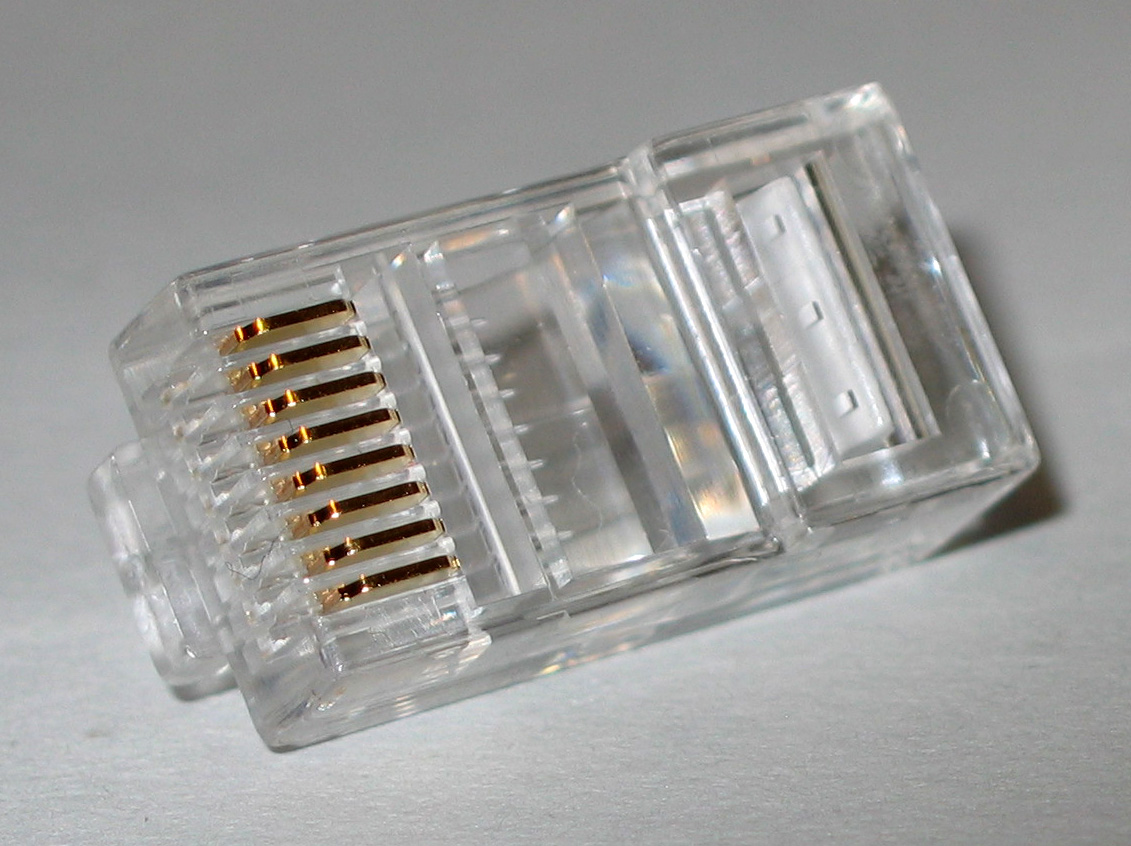
8. RJ45 - Registered jack 45 is a type of receptacle for an 8-pin 8-conductor (8P8C) connector. An 8P8C connector is a small plastic connector with a little plastic tab that we commonly refer to as an RJ45 connector, but technically, it's only the jack that is an RJ45.

9. L6-20 - Locking connector rated 250V 20-amps. The designation comes from the National Electrical Manufacturers Association (NEMA).

10. SSID - Service set identifier is basically the name given to a WiFi network. Why engineers insist on creating acronyms for everything instead of just calling it the WiFi name, I'll never know.

How did you do?

10 correct - Congratulations! You're an Entertainment Tech Superstar!
7 to 9 correct - Not bad!
4 to 6 correct - Could do a little better.
1 to 3 correct - Needs work.
0 correct - Tech emergency!

TAFN
Richard Cadena

Monday, July 8, 2019

3-Phase Power

How does 3-phase power work? Kinda like this...


3-Phase Power from Richard Cadena on Vimeo.

One the left is a 3-phase generator, and on the right is a visualization of the three voltage waveforms. Notice that they are al 120 degrees out of phase with each other.


Friday, March 29, 2019

Dangerous Adapters Still in Service

by Eugene Palmer

Why is it that rigging companies are often the most flagrant violators of electrical safety?  They seem appropriately concerned with safe loads, fall arrest and training, but then send out the most terrifically illegal and genuinely dangerous electrical equipment.

I am speaking of the Cam-Lock to L16-50 or their even more dangerous little brother the L21-30, adapters that continue to show up from rigging suppliers.  These adapters typically have stripped back 10/5 or 8/4 SO with the individual single jacketed conductors then inserted into male Cam-Lock connectors.

There are numerous dangers with this adapter-

They are physically under-protected because the individual conductor jackets are only the internal single jacket not meant for rough service and easily nicked or cut into.

They are physically under-protected because no Cam-Lock is designed for conductors that thin, and fillers used to increase fit are not designed for the physical or electrical load.  The allen set screws are usually screwed in past the threads and stripped.

They are electrically under-protected because they are inevitably connected to anywhere from 100 to 400 amp services whose circuit breakers are more than 25 feet away.

They violate both the spirit and several sections of NFPA code.

So, when a single 10 gauge conductor with its thin jacket gets brushed against a road case burr, or crushed under a pipe and drape base with its sharp edge, the resulting potential’s only safety stop is a 400 amp breaker up in the catwalk, or down the vom and around the corner 150’ in a locked vault only hotel engineers have access to (as is the case today), or worse.  The resulting shock to anyone electrically near, or the resulting flash from touching a grounded piece of hardware, is extremely dangerous and difficult to control or stop.  That breaker is probably not going to trip, and that cable is probably going to erupt in flames, and any person involved is probably going to have serious or fatal burns, and the only way to stop it would be for a an available person to go switch the power off.

While it is possible that riggers themselves are unaware of this danger, rigging shops certainly know, and further, rigging trainers certainly know.   So why does this equipment persist?  I imagine it is the age-old simple answer that it is easier and cheaper so therefore the safety considerations are ignored.  Simple and reasonably priced alternatives are readily available in the form of small ‘lunch-box” power distribution units that have Cam-Lock inputs and properly sized circuit breaking outlets.  Since most rigging companies have specific connector configurations.  I won’t try to specify one, except to say that Lex Products and Motion Laboratories both offer custom configurations for their small form-factor distribution boxes.  Probably about $1000, maybe more, but please put them in your rental inventory and get rid of those adapters.

I am not a confrontational person by nature, but if there were any extreme by which I would refuse to connect and service a production as an ETCP certified electrician, it is this one.  By supplying this sub-standard equipment rigging suppliers put me and other responsible electricians in the very hot seat of possible load-in stoppage when we demand compliance to clearly mandated standards.   Compare this to an ETCP certified rigger refusing to load a show in because all the motors are years out of inspection with rusty chains.  It is not that different, it is equipment seriously and dangerously out of compliance that jeopardizes the health and safety of workers and public, though in this case probably more the workers.  I am refusing to connect these adapters and have so far not had to stop a load-in because I know where house L21-30 outlets or other alternatives are, but there will come a time.

Rather than put this sort of industry criticism up on social media, I thought I would start with a more personal and direct approach to a few people I could locate on the web since my point is not to cause trouble, it is to get results.  These adapters must be taken out of service.  Please forward to the appropriate supervisory persons in your companys rental department and industry members as you see fit.

However, this is not the first time I have made an appeal to industry, and I am still seeing these adapters.  The next step is social media or commercial publications, where I am sure you will be scorched far worse than anything I could come up with.  Please, as ESTA, USITT and ETCP associated people with dedicated concerns for industry safety, make this stop.  If you already have and I am bothering you with known solutions, I apologize, but I bet you all still have them.

Sincerely,

Eugene Palmer
IATSE Local 107
Theater, Dance & Performance Studies, UC Berkeley

Why Wear Shock Protection? This is Why

Rarely will you find me on a gig without gloves on my hands. I have a pair of Gig Gloves that I love to wear when I'm unloading trucks, a pair of buffalo skin gloves that I wear when I'm working around energized electrical cables, and a pair of voltage-rated rubber gloves that I wear when there is a possibility of electric shock (inside the restricted approach boundary for you who speak NFPA 70E). I'm always careful to meter power as far downstream in the power distribution system as I can because, the closer you are to the source of power, the greater the hazard. I cringe when I see people metering power at the camlock connectors on a portable power generator.

Recently, I was doing some research and I came across an OSHA accident report that said an employee touched live energized parts within a power generator.

"At 1:44 p.m. on August 30, 2018, an employee opened the 480 volt 3 phase diesel powered generator's output terminal panel and lifted the output terminal cover. The employee's hand touched energized parts and received a shock through his left hand between the thumb and the index finger, and was electrocuted."

This is why we wear shock protection. Had he been wearing rubber gloves, he would be happily working or relaxing at home with his family today. Even if he was wearing leather gloves, he would have fared much better. Instead, he's another statistic.

It's too late for this employee, but for the rest of us, we should learn from this. We can do better. Wear gloves!


Friday, March 1, 2019

Take Time to Save a Life

As of March 1, 2019, it's been 590 days since the last known fatal stage electrocution.

Barbara Weldens was a singer who liked to perform barefooted. On July 19, 2017, she was performing at the Léo Ferré festival in Gourdon, France when, according to Wikipedia, she stepped on "a faulty electrical device." It cost her life.

Could this have been prevented? What can we learn from the tragedy? How can we prevent similar tragedies in the future?

If the report is accurate, it would seem that the fault in the equipment was broken insulation on a power cable, leading to a live exposed conductor, which is a shock hazard. If she tread barefooted on a power cable with broken insulation, then she would have completed a circuit through her body to the chassis of the handheld microphone, which is connected to the shield of the microphone cable, and that is connected to electrical ground.

This illustrates the importance of visually inspecting all of your power cords and cables when you are setting them up. Had someone spotted the defective cable and removed it from service or repaired it on the spot, then Barbara Weldens would likely be alive today.

That's why I like to carry a roll of self-vulcanizing silicon rubber tape. When the backing on this tape is removed and it is wrapped, it forms a chemical seal and provides a layer of electrical insulation. Depending on the brand of tape, it can offer dielectric strength of thousands of volts per wrap. If I find any defective insulation, I will take the time to wrap it with self-vulcanizing silicon rubber tape. And because it's not very durable, I will cover it with electrical tape. The combination provides electrical insulation with a more durable outer covering. It's not a permanent solution but a temporary one that could save someone's life.

Defects in cable are common in live event production because of the way we handle them. We toss them around, step on them, run over them with hand trucks and fork lifts, and generally beat them up. They can end up with cuts, punctures, slices, abrasions, cracks, and other defects. Insulation is made of polymer, which is a form of plastic. As soon it's made, the insulation starts to break down naturally because of oxidation, moisture (leading to hydrolytic breakdown), heat (leading to thermal degradation), mechanical stress (leading to loss in tensile properties),  the effects of light (especially UV), chemical breakdown (due to atmospheric pollutants like oil residue on the surface of streets), biological breakdown (fungi, mold, etc.), ultrasonic breakdown, and more.

Self-vulcanizing silicon rubber tape is offered by a number of manufacturers under a variety of trade names including Rescue Tape, F4 Tape, Tape 70, and FixIt Tape. The price ranges from about $3.50 per roll (in packs of six) to about $18 per roll. You can find it at your local home improvement store or online.

Take the time to make sure your power distribution equipment is free from defects and you could save a life.